

Extraction arms for industry are popular because they bring local exhaust ventilation to a moving work source. Welding, soldering, grinding, deburring, adhesive work, small powder handling, and maintenance tasks can all benefit from a capture point that can be repositioned. But an extraction arm only works when it stays close enough to influence the plume or dust stream.
If the arm is too short, heavy, loose, noisy, or always in the operator's way, it will be pushed aside. If the hood is too far from the source, the fan may run while the contaminant escapes. OSHA and NIOSH local exhaust guidance both point back to the same practical idea: capture contaminants at or near the source before they disperse.
Reach Is Not the Same as Usable Reach
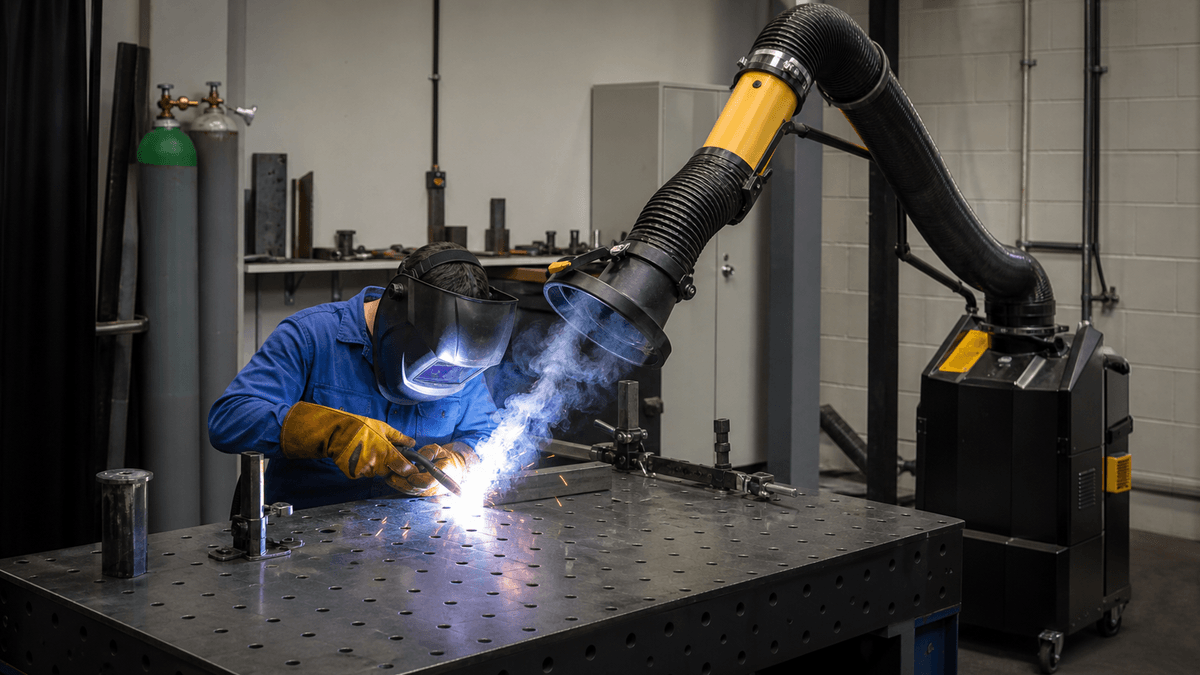
A brochure may list arm length, but the useful question is whether the operator can place the hood where the work actually happens. A welding fixture may block the arm path. A large part may require access from several sides. A bench may be crowded with clamps, tools, and parts. A hood that reaches only the easy position will be left behind during the difficult work.
Mock up the task before choosing the arm. Watch the operator reach, rotate parts, tack weld, grind edges, clean fixtures, and remove finished pieces. If the arm has to be moved every few seconds, the hood may need a different style, a rail, a longer reach, a smaller hood, or a partial enclosure that reduces repositioning.
NAROO's laser processing application context and automotive air filtration and dust removal positioning are relevant when extraction arms support fabrication, fume capture, and mixed process work.
Hood Shape Should Follow the Contaminant
A round hood, flanged hood, nozzle, slot, or small enclosure each changes capture. Welding fume rises as a hot plume. Grinding dust may be thrown by wheel direction. Soldering fumes may rise gently from a small source. Powder handling may create a short release during pouring or dumping. The hood should be selected for the way the contaminant moves.
Do not assume that more suction solves poor hood shape. A small nozzle may need close placement and high velocity. A flanged hood can improve capture by reducing air pulled from behind the hood. A partial enclosure can reduce required airflow. A poorly chosen hood can pull air from the room while the plume passes around it.
For dry fine particulate, NAROO's cartridge dust collector category can support the filtration side of the system. When an industrial cartridge dust collector serves multiple extraction arms, branch balance and filter loading should be checked carefully.
Positioning Habits Decide Daily Performance
An extraction arm is a tool. Like any tool, it needs a habit. Operators should know where the hood belongs for each task, how close it should be, and what visible escape looks like. A smoke test or simple demonstration can show why a hood placed a short distance too far away stops controlling the plume.
Supervisors should inspect real work positions, not staged positions. If the arm is usually parked against the wall, ask why. It may be too stiff, too short, too loud, or poorly located. Fixing the layout may improve capture faster than reminding workers to use a tool that does not fit the job.
Extraction arms are especially useful for variable tasks, but that flexibility brings responsibility. The arm must be placed again after each part move, setup change, or weld sequence. If the process becomes repetitive, a fixed hood or enclosure may be more dependable.
Airflow Must Reach Every Arm in the Network
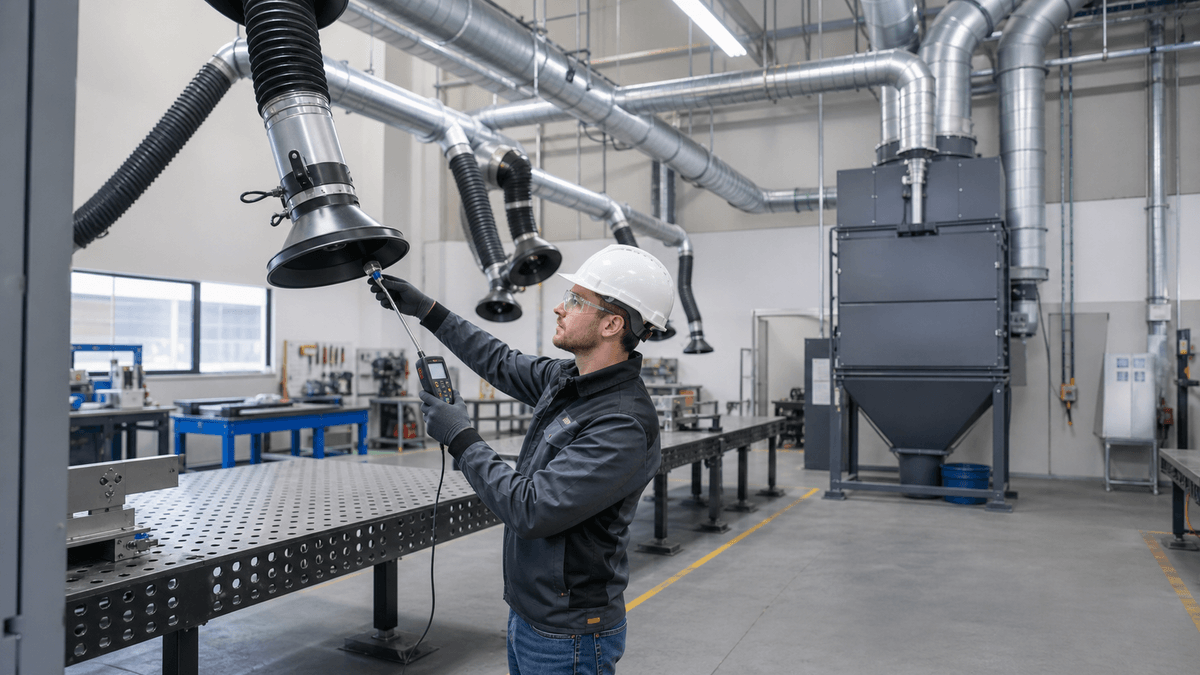
When several extraction arms connect to one collector, open arms compete for airflow. A short branch may pull strongly while a distant arm becomes weak. If too many arms are open at once, capture can drop below what the task needs. If operators leave unused arms open, the system wastes capacity.
Branch dampers, hood position, arm diameter, duct length, and fan selection all matter. Commissioning should measure airflow at each arm under realistic combinations of open and closed arms. The plant should also define which arms can operate simultaneously and whether unused arms should have shutoff dampers.
NAROO's dust removal and air purification product range is useful when extraction arms are part of a broader plant system rather than standalone equipment. The collector, fan, ductwork, and filter cleaning system must support the arm network.
Do Not Combine Every Fume, Dust, and Mist Source
Extraction arms for industry may be used near welding fumes, grinding dust, soldering fumes, powder dust, solvent odors, and light mist. Those streams should not automatically share one collector. Sparks, oily mist, sticky particulate, combustible metal dust, and gas-phase vapors all need separate review.
If the arm captures dry welding fume or fine particulate, cartridge filtration may be appropriate. If it captures heavy process dust, NAROO's bag dust collector category may be a better comparison. If sticky or wet particulate is present, the wetted filter path may need review. If solvent vapor or odor is the main concern, the project may require VOCs Control rather than simple particulate capture.
Maintenance Keeps the Arm Honest
Extraction arms can lose performance quietly. Flexible hose can crack, joints can loosen, dampers can stick, hood lips can clog, and duct branches can accumulate dust. Workers may still hear airflow but capture may have dropped. Regular inspection should include arm position, joint tension, hose condition, hood cleanliness, damper operation, and airflow at the hood.
Filters and collectors also need attention. If pressure drop rises, every arm may weaken. If one arm collects abrasive grinding dust and another collects welding fume, filter loading may change quickly. Pressure trends should be linked to which stations were active, not treated as a generic collector number.
NAROO's design, production, and installation background can support projects where extraction arms, ductwork, collector selection, and commissioning need to be coordinated.
Bench, Wall, Rail, and Portable Layouts
Extraction arms for industry can be mounted on benches, walls, columns, rails, portable units, or central duct networks. Bench and wall arms can work well when the task is stable and the work envelope is small. Rail-mounted arms may suit long seams or moving stations. Portable units can support maintenance work or temporary setups, but they still need enough airflow and filter capacity for the contaminant.
The layout should match production rhythm. A fixed arm near a high-use bench may be more reliable than a portable unit that must be moved and plugged in for every job. A portable unit may be better for occasional repair work away from the main line. A rail can reduce repositioning during long welds but requires structure, duct design, and maintenance access.
Do not let installation convenience decide the layout by itself. The best mounting point is the one that lets the hood stay close to the release while the worker can still see, reach, and move safely.
Testing Should Happen With Real Hands on the Work
Extraction arms are often tested while no one is actually doing the task. That misses the main variable: the operator. Commissioning should include real part handling, normal body position, tools, clamps, fixtures, and the pace of the job. The hood should remain close during the awkward moments, not only during a posed demonstration.
Use smoke visualization, airflow readings, and worker feedback together. If the smoke shows escape when the operator reaches across the part, revise the setup. If airflow is acceptable but workers cannot use the arm comfortably, revise the layout. If the arm works for one product but not another, document which task needs a different capture method.
A short checklist at startup and after layout changes keeps the system alive. Check arm condition, hood position, airflow, filter pressure, and visible capture. Those habits are simple, but they keep local exhaust from becoming background equipment that everyone assumes is working.
Supplier Brief for an Extraction Arm Project
- Task type, contaminant, material, and release pattern.
- Photos or video of the work from several positions.
- Bench height, fixture size, part movement, and operator reach.
- Number of arms, simultaneous use, and duct route.
- Existing collector, filter type, fan data, and pressure history.
- Known hazards such as sparks, combustible dust, toxic metals, mist, or vapor.
The brief should also include worker feedback. If operators dislike the current arm, ask why. Ergonomics is not a soft issue here; it directly affects whether the hood stays close enough to capture.
Good Arms Still Need Boundaries
An extraction arm should not become a catch-all for every nearby task. Define which processes it serves, which materials are allowed, and which work requires a different control. Without boundaries, operators may use the arm for dust, fume, mist, and odor streams that belong in separate systems.
Clear boundaries protect filter performance and maintenance safety. They also help supervisors spot when production has changed enough to require a new ventilation review.
Conclusion
Extraction arms for industry are valuable when the work moves and the contaminant source changes position. They fail when they are treated as decorations beside the workstation. Choose the arm, hood, airflow, filtration, and training around the real task. A close, usable capture point beats a powerful collector connected to a hood that workers cannot keep near the source.