

There Is No One NAROO Dust Collector for Every Plant
A NAROO dust collector should be selected around the dust problem, not around a generic equipment label. Different processes create different particles. Fine dry powder, heavy process dust, coarse chips, sticky particulate, laser fume, battery material dust, and automotive grinding dust all require different capture and filtration thinking.
NAROO is positioned as an industrial dust removal and air purification solutions provider. Its company profile describes a company founded in 2008 with R&D, production, installation, and environmental solution capability. For buyers, that matters because dust control is usually a system decision, not only an equipment purchase.
Fine Dust Often Points Toward Cartridge Filtration
When the dust is fine, dry, and suitable for surface filtration, a cartridge collector can be a practical option. Cartridge filters provide large filter area in a compact arrangement and can use pulse jet cleaning to release dust from the media surface.
NAROO's cartridge dust collector page describes high-efficiency cartridge collectors for fine particle filtration, with surface filtration, pulse jet cleaning, airflow calculation, wind speed, duct layout, pressure loss, and air-to-cloth ratio. Those details are central to collector performance.
A cartridge collector may be useful near powder transfer, mixing, weighing, packaging, laser processing, or other fine-particle sources. It still needs correct hood design, duct balance, filter media, hopper discharge, and maintenance access.
Heavy Dust May Need a Bag Collector
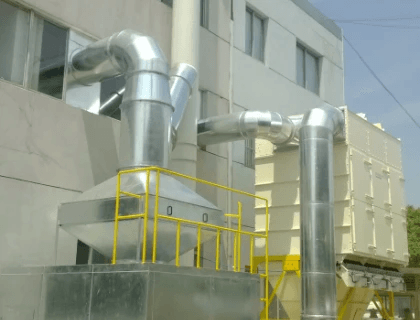
For heavier process dust, a bag collector may be the better starting point. Bag filters use fabric elements to separate dust from the air stream. They are often considered when dust loading is heavier or when a robust filtration approach is needed for larger industrial processes.
NAROO's bag dust collector page describes durable bag filter systems for capturing heavy dust in industrial processes. The related bag filter page explains how dust-laden air passes through woven fabric filter elements and how particles are captured on the outside of the bags.
The decision between cartridge and bag filtration should consider dust load, particle behavior, maintenance access, temperature, moisture, available space, and operating cost.
Coarse Particles Can Benefit From Cyclone Pre-Separation
Sometimes the final filter is overloaded because too many large particles are reaching it. In that case, a cyclone can reduce the load before air reaches cartridge or bag filters. A cyclone dust collector uses centrifugal force and changes in airflow direction to separate heavier particles.
NAROO's cyclone dust collector page describes this pre-separation role and notes that cyclones can reduce the filtration load on high-efficiency collectors. This can improve system stability during continuous operation when the dust stream contains coarse material.
A cyclone is not a universal fine-filter replacement. It works best as part of a staged system when particle characteristics support it.
Sticky or Wet Particulate May Call for a Wetted Filter
Some dusts are difficult for dry filters because they are sticky, wet, or prone to blinding media. In these cases, a wetted filter or wet collection approach may be worth evaluating. Wet systems introduce their own maintenance needs, including water management, sludge handling, and corrosion review, but they can be useful for selected particulate challenges.
NAROO's wetted filter page positions wet scrubbing around fine and sticky particulate emissions. Its aluminum dust collector page is also relevant when buyers are comparing wet collection for certain metal-dust contexts.
Application Context Changes the Collector Choice

NAROO dust collector selection should be tied to the industry and process. Battery manufacturing may focus on fine powder capture and clean production. Automotive manufacturing may include grinding, welding, or parts finishing. Photovoltaic production may emphasize cleanliness. Laser processing may require fume extraction and fine particulate capture.
Relevant NAROO application pages include lithium battery, automobiles, photovoltaics, and laser processing. These application references help buyers think beyond the collector model and focus on process fit.
Questions Before Selecting a NAROO Dust Collector
- Where is dust released, and can it be captured close to the source?
- What are the particle size, dust load, moisture, temperature, and chemistry?
- Is the dust combustible, toxic, sticky, abrasive, or corrosive?
- Will cartridge, bag, cyclone, wet collection, or a staged system fit best?
- How will pressure drop, filter condition, and airflow be monitored?
- How will dust be discharged, stored, and removed from the plant?
- What installation and maintenance support will the project require?
Bottom Line
A NAROO dust collector is best understood as part of an engineered dust-control plan. Cartridge, bag, cyclone, and wetted filter systems each solve different problems. The right choice depends on dust behavior, airflow design, application context, safety review, and long-term maintenance.