

A chemical plant dust collector can have a large fan, fresh filters, and a sophisticated control panel and still leave powder on floors, beams, and nearby equipment. The usual reason is not a lack of collector capacity. It is that dust becomes airborne before the exhaust system gains control of it.
Chemical production creates short, difficult releases at bag dumping, weighing, charging, screening, blending, drying, conveying, and packaging. A practical system begins at those moments. It contains the release, places the pickup point close enough to influence the moving dust, and carries the contaminant to equipment suited to its physical and chemical behavior.
The Collector Cannot Rescue an Open Process

Imagine an operator emptying a sack into an open hopper. The powder falls, displaces air from the vessel, and creates an upward plume. A wall hood several feet away must pull a large volume of room air before it can affect that plume. Cross-drafts from doors, cooling fans, or operator movement can defeat the capture entirely.
A partial enclosure changes the physics. It limits the directions in which dust can travel and lets a smaller, better-positioned exhaust opening draw air inward through the operator access. The same principle applies to drum tipping, mixer charging, sieve discharge, and container filling: containment gives airflow a realistic job.
The Health and Safety Executive's guidance on local exhaust ventilation emphasizes source-oriented hood design, commissioning, testing, and maintenance. Those are connected tasks. A hood cannot be judged separately from the process movement around it.
Walk the Powder Route Before Drawing Ductwork
Start with a plant walk during normal production, changeover, and cleaning. List every point where powder is exposed or accelerated. Note when a lid opens, a flexible connection moves, a bag collapses, a valve discharges, or an operator brushes residue from a surface. Short events often create the highest visible release even when average production looks controlled.
For each source, record the material, batch frequency, temperature, moisture, particle behavior, drop height, opening size, operator position, and nearby air movement. Also identify whether the same duct would receive vapor, mist, or corrosive gas. This source map is more useful than selecting a collector from total floor area or machine count.
NAROO's industrial application work and broader dust collection product range provide a starting point for matching different source conditions to different collection methods.
Dry Dust and Chemical Vapor Need Separate Questions
A dust collector removes particles. It does not automatically remove gases or volatile organic compounds. Chemical plants may release both from the same production area, but that does not mean the streams should be combined without review. Solvent vapor can affect filter media, fire risk, condensation, monitoring, and downstream treatment. Sticky mist can blind a dry filter.
Ask what is actually airborne at each source. A powder charge may need particulate filtration. A solvent fill may need vapor capture and gas-phase treatment. A dryer exhaust may contain particles, vapor, moisture, and heat and may therefore need staged treatment. Defining the contaminant prevents the plant from buying one device for two fundamentally different jobs.
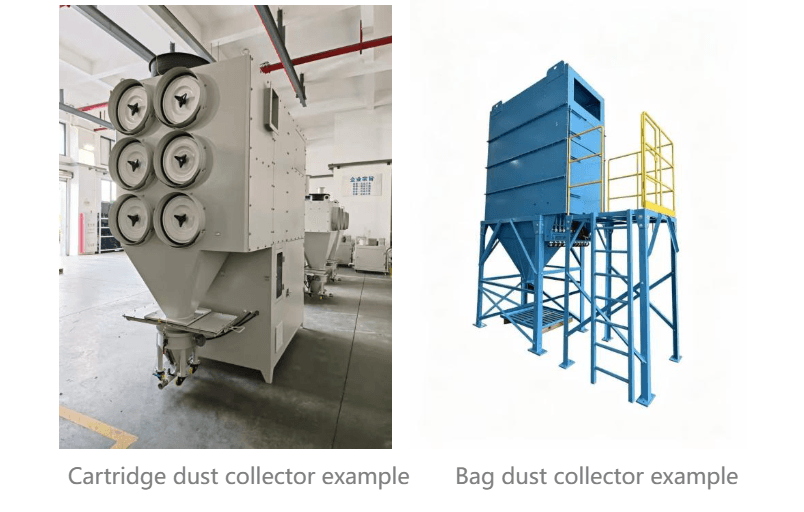
Where fine dry particles are the main problem, a cartridge dust collector can support compact surface filtration and pulse-jet cleaning. Heavier process loading may point toward a bag dust collector. Neither choice should be made before the exhaust composition is understood.
Choose the Hood Around the Task
A good hood works with the natural movement of the contaminant. A receiving hood can take advantage of a directed discharge. An enclosing hood can control a dusty process with less airflow than a remote exterior hood. A downdraft or backdraft arrangement may help at a manual workstation when it does not pull dust through the operator's breathing zone.
The hood must also allow production to continue. If it blocks access, makes containers difficult to position, or slows cleaning, operators will move it or leave doors open. Mocking up an enclosure before fabrication can expose these conflicts. The most useful design review includes the people who run and clean the equipment.
Keep the capture opening close to the release while preserving safe access. Reduce the open face where possible. Avoid placing supply-air jets where they push dust out of the enclosure. For filling points, leave a controlled path for displaced air to enter the exhaust system rather than erupt around the container rim.
The Duct Must Carry Dust Without Creating a New Problem
Duct design connects every pickup point to the collector. Branch balance, transport velocity, pressure loss, abrasion, condensation, cleanout access, and material compatibility all matter. If velocity is too low for the material, dust may settle in horizontal runs. If it is needlessly high, energy use, noise, and wear can rise.
Changes in production can upset a balanced network. Closing one branch, adding a machine, or opening a large access door changes airflow elsewhere. Dampers and controls should support defined operating modes rather than depend on undocumented field adjustments.
For processes with coarse material mixed into the airstream, a cyclone pre-separator may reduce loading on the final filter. It is a system-protection step, not a universal substitute for fine filtration.
Dust Behavior Decides the Filter Path
Particle size is only one selection input. Hygroscopic powder can absorb moisture and form deposits. Resinous or oily material may stick to media. Abrasive particles can wear elbows and inlet components. Very light powder may remain suspended and challenge hopper discharge. Corrosive constituents can affect housings and duct materials.
Dry fine dust often suits cartridge filtration when the process and safety review support it. Heavy loading may favor bag filtration, potentially with pre-separation. Fine or sticky particulate may lead engineers to investigate wet collection; NAROO positions its wetted filter for wet scrubbing of fine and sticky particulate emissions. The complete process, including wastewater or collected-material handling, still requires evaluation.
Provide representative material data and operating conditions to the supplier. A label such as "chemical powder" is too broad for dependable equipment selection.
Combustible Dust Changes the Design Brief
OSHA notes that many materials used in chemical and pharmaceutical production can become explosible when finely divided and suspended in air under the right conditions. A plant should not infer combustibility from appearance or past incident history. Material testing and a qualified hazard review may be needed.
If the dust is combustible, the review extends beyond the filter. It may affect collector location, construction, ignition-source control, grounding and bonding, duct isolation, explosion protection, discharge equipment, housekeeping, controls, and emergency procedures. The applicable requirements depend on the material, process, jurisdiction, and installation.
Do not add an explosion-protection component as an afterthought. The safety strategy and airflow strategy need to be developed together by qualified specialists.
The Hopper Is Part of the Air System
Collected dust must leave the system without being released again. Overfilled drums, leaking rotary valves, poorly sealed bags, and bridging in the hopper can return powder to the room or disrupt collector operation. The discharge method should match dust flowability, batch volume, disposal route, and operator exposure needs.
Plan how containers connect, disconnect, and move. Include access for inspection without forcing workers to open dusty equipment unnecessarily. A clean changeout method often matters as much as filter performance because it controls the last transfer in the dust route.
Commission the Capture, Not Just the Fan
A fan rotation check and airflow reading are not enough. Commissioning should confirm that each hood captures the real release under representative production conditions. Observe bag emptying, full-rate transfer, vessel charging, startup, shutdown, and container changeout. Use appropriate visualization or measurement methods to see whether contaminants escape.
Record branch airflows, pressure readings, fan settings, damper positions, filter differential pressure, and operating modes. These values become the baseline for maintenance. EPA guidance for fabric filters identifies outlet particulate concentration, pressure differential, temperature, flow, cleaning operation, and fan current among useful performance indicators, depending on the installation.
Train operators to recognize early warning signs: a weak inward draft, dust tracks around access doors, rising pressure drop, frequent cleaning pulses, fan current changes, visible outlet emissions, or dust accumulating in ducts and hoppers.
Build a Better Supplier Brief
Give potential suppliers a process description instead of only an airflow target. Include source drawings, powder safety data, available test results, operating schedule, batch peaks, temperature and humidity, current problems, required operating modes, discharge preferences, available utilities, space limits, and maintenance access.
Ask for an explanation of hood logic, airflow calculations, collector choice, pressure-loss assumptions, cleaning method, controls, discharge arrangement, commissioning scope, and documentation. NAROO describes an integrated approach from research and design through production and installation on its company profile. That full-system perspective is useful when the pickup points, duct network, collector, and plant workflow must operate as one system.
FAQ
Can one chemical plant dust collector serve several machines?
Yes, when simultaneous demand, branch balance, contaminant compatibility, cleaning, and safety are engineered for the shared system. Incompatible streams or independently changing processes may be better separated.
Should a chemical dust collector remove VOCs too?
Particle filters generally do not provide complete gas-phase VOC treatment. Dust and vapor streams should be characterized, and each contaminant should have an appropriate capture and treatment path.
Why does dust escape even when measured airflow is high?
The airflow may be measured in the duct but not effectively influence the release. Hood distance, enclosure openings, cross-drafts, process momentum, and displaced air can all defeat capture.
Which is better, a cartridge or bag collector?
The answer depends on particle behavior, loading, temperature, moisture, process chemistry, maintenance goals, safety findings, and available space. Product type should follow source characterization.
The Practical Decision
A successful chemical plant dust collector project begins with the powder route, not the equipment catalog. Contain each release, place the pickup where it can control the plume, keep incompatible contaminants on appropriate treatment paths, and design the duct, filter, discharge, controls, and maintenance plan as one operating system.