

Why Inerting Is Discussed in Dust Collection
An inerting system for dust collector safety is designed to reduce the oxygen concentration inside a protected part of the process so that a combustible dust cloud cannot ignite under defined conditions. Instead of relying only on venting, isolation, suppression, or ignition-source control, inerting changes the atmosphere itself. Most systems use nitrogen, although other inert gases may be considered depending on the material and process.
Inerting can be powerful, but it is not a simple add-on for every dust collector. A dust collector handles moving air, dust loading, filters, hoppers, ducts, and process connections. If the collector is part of an open ventilation system that continuously pulls in fresh air, maintaining a low-oxygen atmosphere may be difficult or impractical. If the dust is reactive with certain gases, the wrong inerting strategy can introduce new risks.
This article explains how an inerting system can fit into dust collector explosion prevention, what engineers should evaluate before selecting it, and how it relates to NAROO's broader dust control, ATEX-aware, and explosion-proof dust collection solutions.
How an Inerting System Works
A dust explosion generally requires fuel, oxygen, an ignition source, dispersion, and confinement. Dust collectors can create several of these conditions because they capture fine particles, move dust-laden air, and contain dust clouds inside vessels, filters, ducts, or hoppers. Inerting targets the oxygen side of this hazard picture.
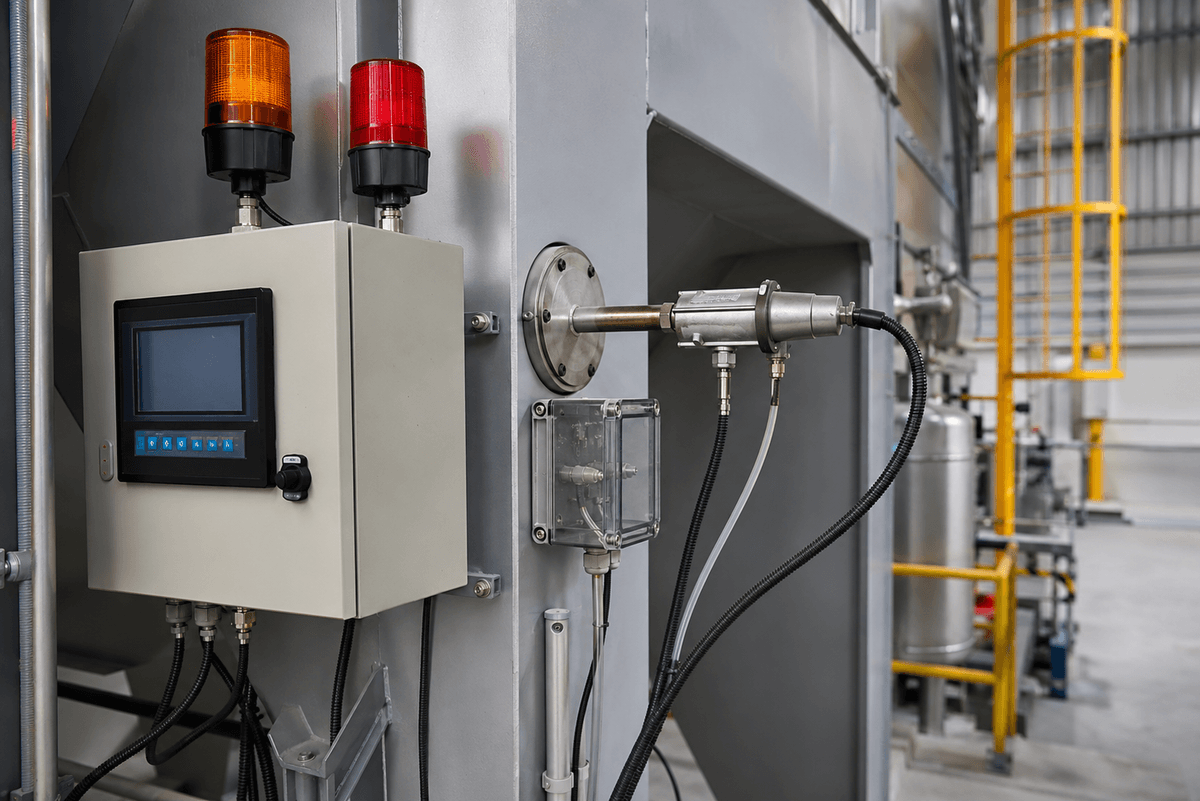
In a typical inerting concept, nitrogen or another inert gas is introduced into a protected volume to displace oxygen. The system may include gas supply, injection points, oxygen analyzers, alarms, valves, control logic, purge sequences, and interlocks. The goal is to keep oxygen below a defined safe limit, usually based on the dust's limiting oxygen concentration, process conditions, and required safety margin.
For dust collectors, this strategy must be engineered carefully. The collector may have continuous airflow, filter pulse cleaning, discharge devices, rotary valves, hoppers, access doors, and connections to upstream equipment. Any leakage or uncontrolled air ingress can increase oxygen concentration and reduce protection. That is why inerting is best treated as a process safety system, not simply a nitrogen line connected to a collector.
When Inerting May Be Considered
Inerting is most relevant when the dust collector handles combustible dust in a relatively controlled or enclosed process where oxygen concentration can be monitored and managed. It may be considered for powders with low ignition energy, fine particle size, high explosion severity, sensitive materials, expensive production equipment, or processes where explosion venting is difficult because of indoor location, toxicity, environmental constraints, or equipment layout.
Industries that may evaluate inerting include chemical processing, pharmaceutical production, metal powder handling, battery materials, additive manufacturing powders, and specialty powder processing. In these environments, dust collectors may be part of a larger containment or process safety strategy rather than a simple housekeeping system.
NAROO's ATEX compliant dust control systems article discusses dust control in potentially explosive atmospheres, including explosion venting, spark detection, and specialized filters. Inerting can be another prevention layer in selected applications, but it must be designed around the specific dust, process, and safety requirements.
When Inerting May Not Be Practical
Not every dust collector is a good candidate for inerting. Many industrial dust collectors are designed to move large volumes of air from open capture points. If the system continuously draws room air through hoods and ducts, the oxygen load may be too high for practical inerting. In such cases, the nitrogen consumption could be excessive, the system may fail to maintain target oxygen levels, or operating cost may become unrealistic.
Some dusts also require special caution. Carbon dioxide and nitrogen are commonly discussed inert gases, but certain metal powders can behave unexpectedly with some gases under specific conditions. For reactive or pyrophoric materials, the inert gas, oxygen concentration, humidity, temperature, and material properties must be reviewed by qualified process safety specialists.
In many facilities, a better strategy may involve explosion venting, flameless venting, explosion suppression, isolation valves, spark detection, housekeeping, safe conveying velocity, or wet collection. NAROO's NFPA 68 dust collector explosion venting resource is relevant when the goal is to relieve pressure safely during a deflagration rather than prevent ignition through oxygen reduction.
LOC Testing and the Role of Oxygen Monitoring
The limiting oxygen concentration, often called LOC, is a key value for inerting system design. LOC testing determines the oxygen level below which a dust cloud cannot propagate combustion under specified test conditions. The chosen operating oxygen concentration must then include an appropriate safety margin below the relevant LOC value.
Because LOC depends on dust properties, particle size, moisture, temperature, pressure, inert gas type, and test method, it should not be guessed. A reliable inerting system for dust collector protection requires dust testing and process data. Without that information, the facility cannot know whether the target oxygen level is low enough or whether the system can maintain it during normal and abnormal operating conditions.
Oxygen monitoring is also central. Sensors should be located where they reflect the protected volume, not just a convenient sample point. The system should include alarms, interlocks, and defined responses if oxygen rises above the allowed limit. A nitrogen supply failure, open access door, leaking seal, failed valve, or changed production condition can all compromise protection.
NFPA 69 and Explosion Prevention Thinking
In North America, NFPA 69 is commonly associated with explosion prevention systems, including oxidant concentration reduction and inerting concepts. The standard framework reinforces an important principle: inerting is an engineered safety system that requires defined design basis, monitoring, reliability, and maintenance. It is not simply a performance enhancement.
For dust collectors, inerting should also be considered alongside other combustible dust standards and facility obligations. NFPA 652, NFPA 654, NFPA 484 for combustible metals, and other industry-specific standards may be relevant depending on the material and process. OSHA's combustible dust guidance also emphasizes the need to prevent and mitigate dust fires and explosions in industrial facilities.
NAROO's certification page highlights the company's focus on safety, performance, and international requirements such as CE, ATEX, and UL. For an inerting-related project, this type of safety-aware supplier positioning should be paired with a formal hazard analysis and qualified engineering review.
How Inerting Fits With Explosion Venting and Suppression
Inerting is a prevention method. Explosion venting, flameless venting, suppression, and isolation are mitigation methods. Prevention tries to stop an explosion from occurring. Mitigation assumes an explosion may still occur and limits its consequences. A dust collector safety strategy may need one or both approaches depending on the hazard analysis.
For example, a closed powder handling process may use nitrogen inerting to reduce oxygen concentration, while also including isolation devices to prevent flame propagation. Another system may not be suitable for inerting but may use explosion venting, flameless venting, or suppression to reduce event severity. A third system may combine spark detection, isolation, and explosion-resistant collector design.
NAROO's explosion-proof dust collector article explains the importance of specialized equipment in environments with flammable dust or vapors. Inerting should be viewed as part of that broader safety conversation, not as a replacement for all other protection measures.
Design Questions for a Dust Collector Inerting System

Before specifying an inerting system, the engineering team should define the dust hazard. What is the Kst value, Pmax, minimum ignition energy, minimum ignition temperature, and LOC? Is the dust conductive, metallic, reactive, hygroscopic, toxic, or combustible only under certain process conditions? Are dust properties representative of the actual material handled by the collector?
Next, define the protected volume. Is inerting intended for the collector housing, inlet duct, hopper, upstream vessel, downstream equipment, or a closed recirculation loop? Does the system include open capture hoods, leakage points, airlocks, rotary valves, cleanout doors, or filter pulse jets that can introduce oxygen? The design must address how oxygen enters and how inert gas is distributed.
Finally, define control philosophy. What oxygen concentration triggers alarms? What concentration stops the process? What happens if nitrogen pressure drops? How are sensors calibrated? What is the purge sequence before startup? How does the system return to safe operation after maintenance? These questions help separate a robust inerting design from a symbolic nitrogen connection.
Inerting in Lithium Battery and New Energy Dust Collection
Lithium battery manufacturing and new energy material processing often involve fine powders, sensitive product quality requirements, and demanding safety expectations. Dust extraction in these environments may need to manage combustible or reactive dust, process cleanliness, product contamination, and explosion protection at the same time.
NAROO's lithium battery dust collection page describes advanced explosion-proof dust collection systems designed for lithium battery production. In selected powder handling steps, inerting may be evaluated as part of a larger atmosphere-control or process safety strategy, especially where dust explosibility and process enclosure make oxygen control feasible.
However, lithium battery materials require careful material-specific review. Some powders may have unique reactivity, moisture sensitivity, or contamination concerns. The decision to use nitrogen, another inert gas, wet collection, isolation, venting, or suppression should be based on testing, process conditions, and safety standards rather than a generic assumption.
Collector Type and System Layout Matter
The physical dust collector design affects whether inerting can work. A cartridge collector, bag filter, cyclone, or wet filter may have different airflow behavior, dust storage, cleaning cycles, and sealing requirements. Open systems with many capture points are harder to inert than enclosed process vessels or closed collection loops.
NAROO's product center notes that its dust collectors can be customized with capture hoods for different processes and include safety features such as explosion-proof capabilities, early-warning alerts, and system linkage functions. These are relevant considerations when designing a collector around either explosion prevention or mitigation.
For some applications, a wetted filter or wet collection approach may be more suitable than dry collection with inerting, particularly when dust type and process conditions support wet capture. For other applications, a sealed dry collector with oxygen monitoring may be more appropriate. The best design depends on the dust, process, location, and risk analysis.
Maintenance and Reliability Requirements
An inerting system only protects the dust collector if it continues to operate as designed. Nitrogen supply, analyzers, sampling lines, valves, injection points, alarms, seals, and control logic all require inspection and maintenance. A failed oxygen sensor or blocked sample line can create false confidence.
Maintenance procedures should define calibration frequency, alarm testing, purge verification, leak checks, nitrogen supply checks, and restart procedures after shutdown or access. Operators should understand that opening the collector, changing filters, clearing hoppers, or modifying ductwork may introduce oxygen and require a safe purge sequence before returning to operation.
Because dust collector maintenance often involves both mechanical and safety systems, training is essential. EHS teams, maintenance personnel, process engineers, and operators should all understand the role of inerting and the conditions that can defeat it.
Questions to Ask a Supplier
When discussing an inerting system for dust collector protection, ask the supplier whether the process is suitable for inerting at all. Can the collector be sealed well enough? How much air ingress is expected? What inert gas consumption is required? Where will oxygen be measured? What alarms and interlocks are included? How will the system be commissioned and verified?
Ask how inerting interacts with existing explosion venting, suppression, or isolation devices. Ask whether the dust collector design supports access, filter changeout, hopper discharge, and cleaning without defeating the inerting strategy. Ask what information the supplier needs from dust explosibility testing and process hazard analysis.
NAROO's company profile describes a full process from R&D and design through production, sales, and installation. For complex explosion prevention projects, that system-level approach matters because inerting is not only a component purchase. It is an engineered safety concept that must be integrated with the dust collector, ductwork, process equipment, controls, and maintenance plan.
Conclusion
An inerting system for dust collector safety can be a valuable explosion prevention method when the process is suitable, the dust hazard is understood, and oxygen concentration can be reliably controlled. It is especially relevant for selected enclosed powder handling, chemical, pharmaceutical, metal powder, battery material, and specialty industrial processes.
At the same time, inerting is not a universal solution. Open dust extraction systems, high air ingress, unknown dust properties, reactive materials, poor sealing, or weak maintenance practices can make inerting ineffective or impractical. Facilities should evaluate inerting alongside venting, suppression, isolation, wet collection, housekeeping, ignition control, and formal combustible dust hazard analysis.
NAROO can be considered as a dust removal and air purification solution partner for facilities evaluating explosion-proof dust collection, ATEX-aware dust control, lithium battery dust removal, wet filtration, and customized dust collector safety strategies. Final inerting design, safety validation, and compliance decisions should be based on qualified engineering analysis, dust testing, and applicable standards.