

A Factory Visit Should Start With Engineering Questions
When buyers search for an industrial dust collector factory in China, the first things they often see are housings, filters, fans, welding areas, and product photos. Those details matter, but they do not prove that the dust collection system will work in a real plant. The more important question is whether the factory can translate a dusty process into a stable capture, filtration, discharge, and control system.
A good industrial dust collector factory in China should ask about dust type, particle size, air volume, duct layout, operating temperature, moisture, combustibility, maintenance access, and installation conditions before recommending a model. If the conversation starts and ends with cabinet size, filter count, or price, the buyer may be comparing metal boxes rather than engineered systems.
NAROO's company profile describes the company as a high-tech environmental solutions provider integrating R&D, production, and installation. That integrated structure is important because dust collector performance depends on design decisions made long before equipment leaves the factory.
Look Beyond the Collector Shell
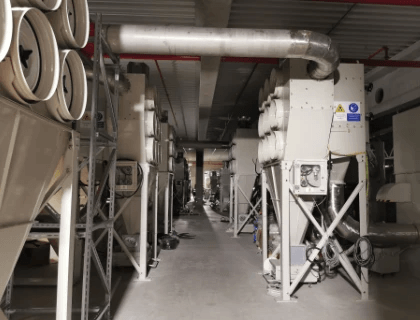
The collector housing is only one part of the job. Dust must be captured at the source, moved through ductwork, separated or filtered, discharged safely, and monitored during operation. A factory that can build a clean-looking collector may still underperform if it does not understand hood capture, duct velocity, pressure loss, air-to-cloth ratio, pulse cleaning, hopper behavior, and fan selection.
NAROO's cartridge dust collector page emphasizes surface filtration, pulse jet cleaning, airflow calculation, pressure loss, and air-to-cloth ratio. These are the types of engineering details buyers should expect to discuss with a serious supplier.
For heavier dust loads, NAROO's bag dust collector page shows another route, using fabric filter elements to separate dust from process air. A reliable factory should be able to explain why one technology fits a process better than another.
Check Whether the Factory Designs Systems or Only Sells Units
Some buyers need a standalone collector near one process point. Others need a full system with multiple hoods, branches, fans, dampers, explosion protection review, discharge devices, controls, and commissioning support. The difference is significant. A unit seller may quote quickly, but a system-capable factory should ask for drawings, process flow, dust data, and operating priorities.
Ask how the factory calculates airflow. Ask whether duct resistance is included. Ask how filter media is selected. Ask how pressure drop will be monitored. Ask how dust will be discharged and collected. Ask what maintenance tasks operators will need to perform. These questions reveal whether the supplier is thinking like an engineering partner.
NAROO's dust collection product center includes cartridge, bag, cyclone, and wet collection categories. This broader product range helps buyers avoid forcing every dust problem into one collector type.
Match the Factory to the Application
Different industries generate different dust problems. Lithium battery powder is not the same as metal grinding dust. Laser cutting fume is not the same as heavy mineral dust. Sticky particulate is not the same as dry fine powder. A buyer should ask whether the factory has application experience related to the process, not just general dust collector production experience.
NAROO provides application pages for lithium battery, automotive manufacturing, photovoltaics, and laser processing. Those pages help buyers connect product selection with real industrial environments.
Application fit is especially important when the dust is combustible, abrasive, corrosive, fine, sticky, or tied to product cleanliness. A factory should be willing to discuss the process conditions that make a standard design risky or inefficient.
Safety Documentation Should Not Be an Afterthought
Combustible dust can create fire and explosion hazards in dust collectors, ducts, hoppers, and discharge equipment. OSHA identifies combustible dust as a recognized industrial hazard, and NFPA 660 provides a consolidated combustible dust standard framework. Buyers should not assume that any industrial dust collector factory in China automatically provides the right safety configuration for every dust type.
Ask what dust data the supplier needs before selecting explosion venting, suppression, isolation, grounding, or electrical features. Ask what certifications apply to the specific product being quoted. Avoid broad claims that every collector is suitable for explosive atmospheres unless the supplier provides project-specific documentation.
Safety requirements depend on dust properties, installation location, local rules, and the authority having jurisdiction. A serious factory should help identify the questions that need review, even when final compliance decisions rest with the facility owner and local professionals.
A Practical Buyer Checklist
- Request engineering inputs, not only a model number and price.
- Confirm airflow calculation, duct resistance, pressure loss, and fan selection.
- Ask why cartridge, bag, cyclone, or wet collection is recommended.
- Review filter access, hopper discharge, compressed air needs, and controls.
- Check application experience with similar dust and production conditions.
- Ask about combustible dust review when material properties require it.
- Confirm installation, commissioning, spare parts, and service support.
Bottom Line
The right industrial dust collector factory in China is not simply the one with the lowest quote or the most product photos. It is the one that understands dust behavior, airflow, filtration, discharge, safety, and maintenance as one system. Buyers who verify those details early are more likely to receive equipment that performs after installation.