

A powder handling dust collector should control dust during the few seconds when material drops, containers fill, bags collapse, and access doors open. If the design is based only on room volume or a collector airflow number, it may spend energy moving clean air while powder escapes beside the process.
The practical goal is to keep powder from becoming a room-wide cloud. Reduce the energy of the release, contain it, pull air in the right direction, and move the captured material through equipment that can handle its real loading and behavior.
Every Dust Cloud Is a Process Clue
Visible dust tells you how the process is moving air. A plume rising from a hopper suggests displaced air has no controlled exit. A cloud following a falling stream points to excessive drop height or entrainment. Dust puffing from a flexible connector may indicate a pressure pulse, poor seal, or blocked vent path.
Do not start by turning up the fan. Observe when the release begins, which way it moves, how long it lasts, and where the operator stands. Record the powder rate, particle characteristics, container size, drop distance, equipment cycle, and nearby cross-drafts. Slow-motion video and suitable dust visualization can help qualified teams understand brief events.
HSE guidance recommends preventing contaminants from entering workplace air where possible and using effective local exhaust ventilation. Source reduction and capture work best together.
Lower the Drop Before Increasing Airflow
A long free fall gives powder time to accelerate and entrain surrounding air. Shortening the drop, using a telescopic loading device, controlling feed rate, or keeping the discharge close to the rising product level can reduce the plume before extraction begins.
At vessel charging points, material displaces its own volume of air. A fast fall can increase that induced airflow. The receiving vessel needs a controlled air path so dusty air moves toward the pickup rather than out through the largest opening.
Gentler handling can also reduce product degradation and dust generation. Equipment speed, impact points, and abrupt direction changes deserve attention when dust is created inside the handling system rather than merely released from it.
Give Air One Clear Way Into the Enclosure
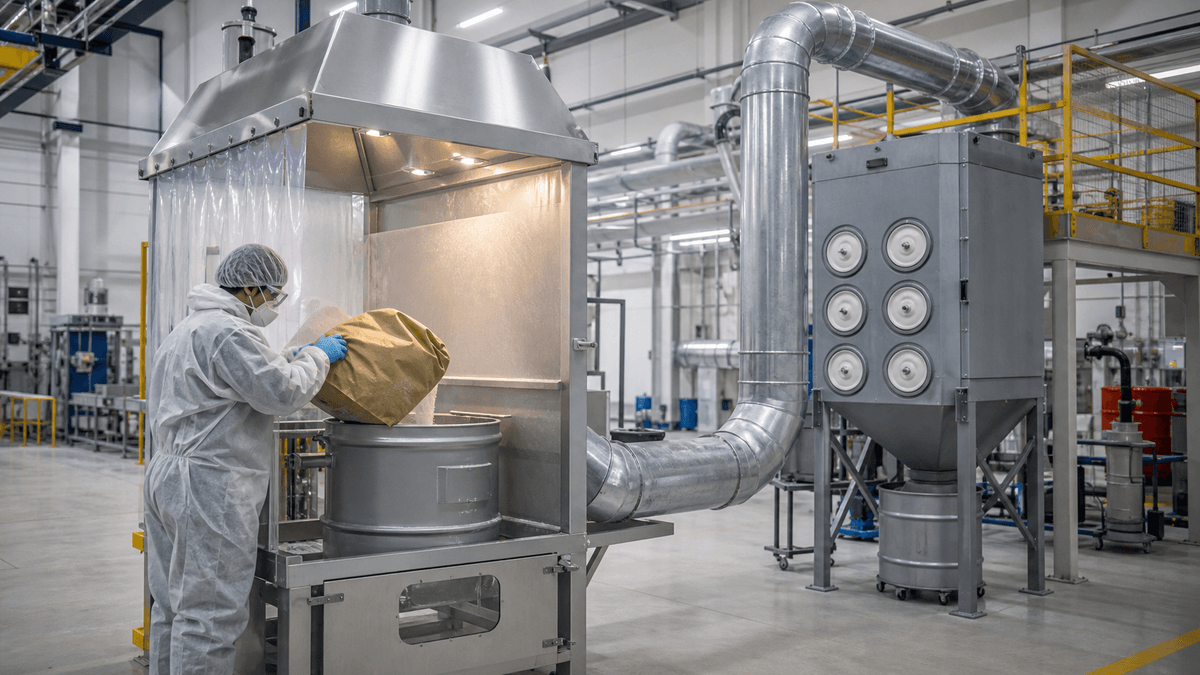
Partial enclosure is often more effective than a distant hood because it limits escape routes. At a bag dump station, side and top panels can contain the plume while an inward flow across the operator opening carries dust away from the breathing zone. A strip curtain or sized access opening may help without making the task awkward.
The exhaust opening should support the natural dust path. Pulling from the wrong side can draw powder through the operator's workspace or remove excessive product. Enclosures also need room for container positioning, liner handling, and cleaning. A hood that interferes with the job will not stay in its designed configuration.
NAROO's industrial dust collection range can be considered after each source has a workable capture concept.
Bag Dumping, Filling, and Conveyor Transfer Need Different Pickups
Bag dumping creates a manual, intermittent plume close to the operator. A ventilated enclosure should capture both the initial pour and the dust released when the empty bag is rolled or discarded. Waste handling belongs inside the control zone.
Bag or tote filling produces a different event. Dusty air is displaced as the container fills, and the changing product level affects the plume. A ventilated collar, contained connection, or filling enclosure can control the release while allowing the container to expand correctly.
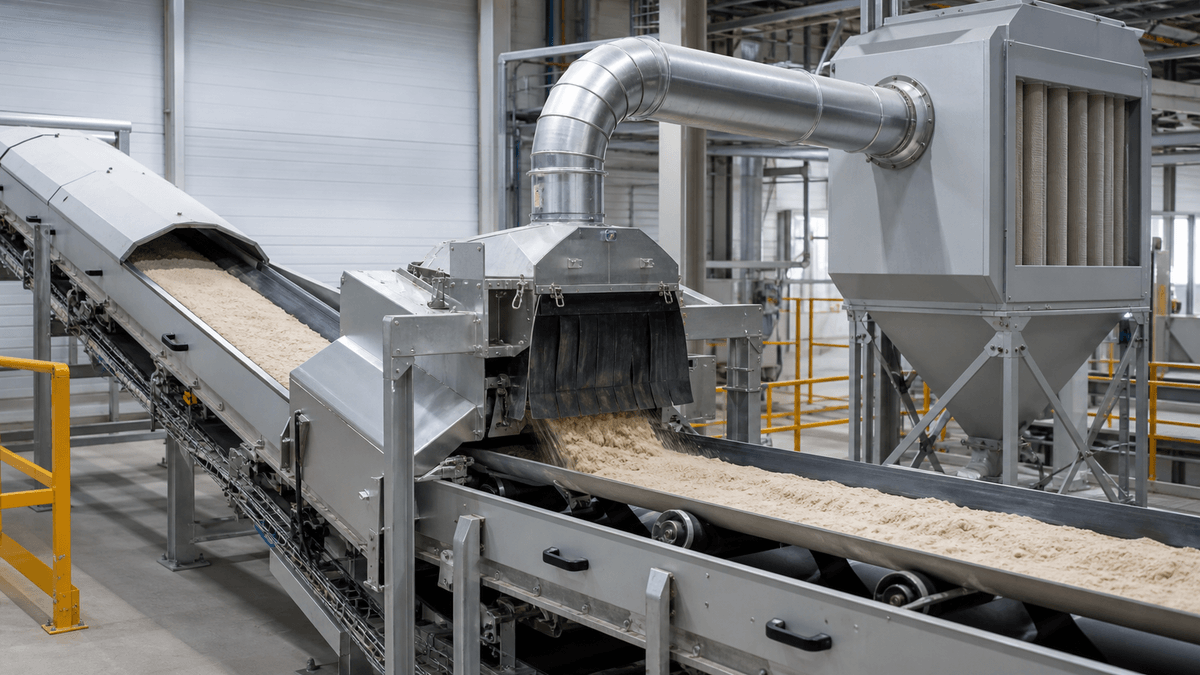
Conveyor transfer points combine impact, induced air, belt speed, and moving material. Skirting and enclosure contain the source; pickup airflow maintains inward leakage at necessary openings. The design should avoid removing large amounts of saleable product from the belt.
Collector Choice Starts With the Dust Load
Fine, dry powder and compact installations often lead engineers to investigate a cartridge dust collector. NAROO describes surface filtration, pulse-jet cleaning, and airflow-resistance calculations for this product category. The design still needs the correct air-to-media relationship and inlet arrangement for the actual loading.
Heavy continuous dust may point toward a bag dust collector. Fabric bags can suit demanding process-dust service when media, cleaning, temperature, and chemistry are properly matched.
Where a transfer stream carries coarse particles, a cyclone pre-separator can remove part of that load before final filtration. This can protect filters and improve system stability, but fine-particle performance still depends on the downstream collector.
Sticky Powder Rewrites the Rules
Moist, oily, resinous, or hygroscopic powder may adhere to filters, hoppers, and ducts. A dry collector selected from particle size alone can experience rapid pressure rise or difficult discharge. Temperature and humidity changes may turn a free-flowing sample into a cohesive deposit.
For fine and sticky particulate, wet collection may be evaluated. NAROO positions its wetted filter around wet scrubbing. That choice introduces other questions, including liquid management, corrosion, collected solids, freezing conditions, and process compatibility.
Representative samples and operating data matter. Provide bulk density, moisture, temperature, particle distribution if available, flowability, abrasiveness, combustibility information, and any tendency to smear or react.
Do Not Let the Duct Become Storage
Captured powder must remain moving until it reaches the separator. Low velocity, poor branch balance, abrupt expansions, unnecessary horizontal runs, and unused branches can encourage settlement. Deposits increase maintenance and may create additional risk depending on the material.
Excessive velocity is not a free solution. It increases pressure loss, power demand, noise, product carryover, and wear. The transport design should match the powder and account for all intended combinations of operating branches.
Provide inspection and cleanout access in locations chosen by the system designer. Changes to dampers, branch use, or machine connections should trigger a balance review rather than an informal adjustment.
Collected Powder Still Has to Go Somewhere
A full hopper can undermine an otherwise healthy collector. Bridging holds dust above the outlet. A leaking valve admits unwanted air. An unsealed drum releases dust during discharge. The selected device must handle the powder's flowability and the required removal schedule.
Design the container-change method before finalizing the equipment layout. Operators need space to disconnect, close, label, and move containers without spilling material. If recovered powder will be reused, quality and contamination controls must be established by the process owner. If it is waste, the disposal route should preserve containment.
Combustible Powder Requires Its Own Review
OSHA explains that finely divided combustible material can become explosible when suspended in air under certain conditions. Powder-handling systems can contain the fuel, dispersion, confinement, and potential ignition sources needed for a severe event.
A qualified hazard assessment may require material testing and consideration of collector location, ignition control, grounding and bonding, explosion protection, isolation, housekeeping, ductwork, discharge, and emergency response. The applicable solution depends on the material and jurisdiction. Do not assume that a familiar product is noncombustible or that a collector marketed for dust is automatically suitable.
Use Pressure and Observation Together
Filter differential pressure is useful, but it does not prove source capture. A normal pressure reading can coexist with an open access door, disconnected flex hose, blocked branch, or poorly positioned hood. Combine collector indicators with routine checks at the source.
EPA guidance identifies outlet particulate concentration, pressure differential, temperature, exhaust flow, cleaning operation, and fan current as potential fabric-filter performance indicators. The exact monitoring plan should reflect the equipment and permit conditions.
During commissioning, establish baseline airflow, pressure, fan settings, and cleaning behavior. Then observe full-rate loading, low container levels, start-stop cycles, and container changeout. A powder handling dust collector should be proven during the release, not only while the process is idle.
What a Useful Request for Quotation Includes
Give suppliers process information: source dimensions, material data, transfer rates, drop heights, operating schedule, simultaneous sources, temperature, humidity, current dust observations, utilities, layout limits, discharge preference, and available hazard information. Photos and videos of the task can reveal details a machine list cannot.
Ask how the design reduces dust generation, contains each release, calculates airflow, balances branches, selects filtration, handles collected powder, and verifies performance. NAROO's company profile describes integrated research, production, and installation capabilities, a useful model for coordinating process interfaces with dust collection equipment.
FAQ
Can the same collector serve bag dumping and conveyor transfer?
It can when the materials are compatible and the system is designed for simultaneous demand, branch balance, peak loading, safety, and operating modes. Separate systems may be better when processes or hazards differ.
Why does adding airflow sometimes increase product loss?
High or poorly directed airflow can pull valuable powder into the duct. Better enclosure and hood placement may improve capture while requiring less air.
Should collected powder be returned to production?
That is a process-quality decision involving contamination, traceability, material condition, and applicable requirements. Dust collection equipment alone cannot establish reuse suitability.
When should a cyclone be added?
Consider it when coarse loading is substantial and pre-separation can protect final filters. Suitability depends on particle behavior, space, pressure loss, and required final collection performance.
Control the Release, Then Size the Machine
The most effective powder handling dust collector starts with a quieter, shorter, more contained transfer. Once the source is controlled, the hood, duct, filter, discharge, monitoring, and maintenance system can do their jobs with less wasted airflow and fewer surprises.