

Why Combustible Dust Standards Matter
A combustible dust standard is not just a technical document for safety specialists. It can affect how a facility designs dust collectors, selects explosion protection, handles housekeeping, trains workers, and documents risk control. Fine dust from materials such as wood, aluminum, magnesium, plastic, grain, sugar, pharmaceuticals, chemicals, and battery powders can burn or explode when dispersed in air under the right conditions. When dust is collected, conveyed, filtered, or stored, those hazards can become concentrated inside equipment.
Dust collectors are essential for clean air and production control, but they can also become part of the combustible dust hazard if not designed and maintained properly. A collector may contain fuel, air, confinement, turbulence, and potential ignition sources. That is why combustible dust standards often focus on dust hazard analysis, ignition control, explosion venting, explosion suppression, isolation, housekeeping, and safe dust collection design.
What Is Combustible Dust?
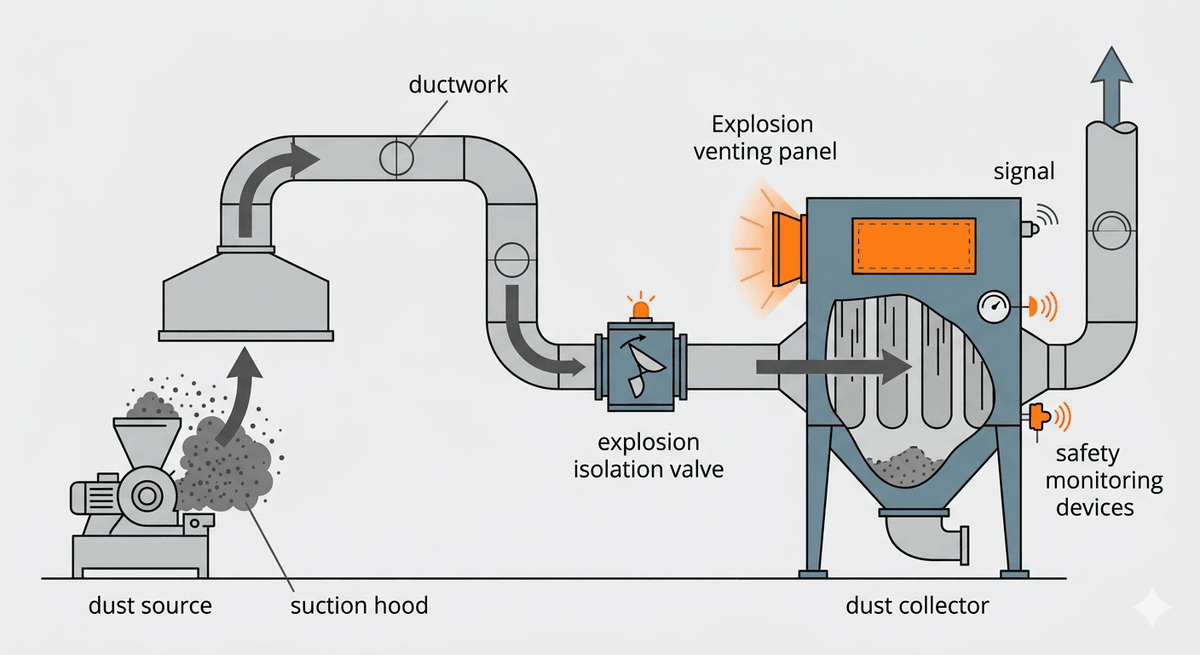
Combustible dust is finely divided solid material that can ignite or explode when dispersed in air and exposed to an ignition source. OSHA's combustible dust National Emphasis Program identifies examples such as metal dust, wood dust, coal and other carbon dusts, plastic dust and additives, biosolids, organic dust, and certain textile materials. The exact hazard depends on material properties, particle size, moisture, dispersion, concentration, confinement, oxygen, and ignition energy.
Some materials that appear harmless in bulk form can become hazardous as fine dust. A block of wood, a bag of grain, or a piece of aluminum may not behave like a suspended cloud of fine particles. When material is ground, sanded, milled, cut, polished, dried, mixed, conveyed, or collected, particle size and surface area can change the fire and explosion behavior.
NAROO's comprehensive guide to combustible dust explains that combustible dust risks can appear in many industrial sectors and that proper dust management is essential. For facilities, the first step is to identify whether the dust being generated can burn or explode under expected or abnormal conditions.
Is There One Combustible Dust Standard?
There is no single universal rule that answers every combustible dust question for every facility. In the United States, OSHA provides mandatory standards that address certain aspects of combustible dust hazards, and the General Duty Clause may apply when a recognized hazard is not covered by a specific standard. OSHA also points to NFPA consensus standards as guidance, while noting that these consensus standards are not OSHA regulations unless adopted by a state, local authority, company requirement, insurance requirement, or other governing body.
Historically, facilities often had to consult several NFPA standards depending on dust type and industry. These included NFPA 652 for fundamentals, NFPA 654 for many combustible particulate solids, NFPA 484 for combustible metals, NFPA 61 for agricultural and food processing facilities, NFPA 664 for wood processing, and other documents. This created complexity for facilities that handled more than one dust type or operated across multiple processes.
NFPA 660, the 2025 Standard for Combustible Dusts and Particulate Solids, consolidates combustible dust requirements into one standard framework. Facilities should still verify which edition, codes, local requirements, and authority-having-jurisdiction expectations apply to their project. The practical takeaway is that combustible dust safety is standard-driven, but the applicable requirements depend on material, industry, location, and process.
OSHA Expectations for Combustible Dust
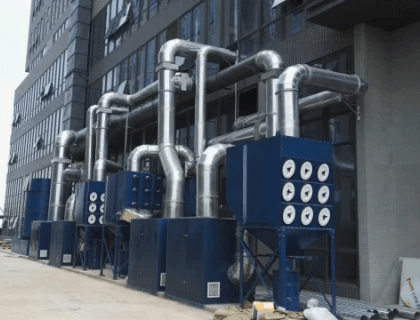
OSHA does not have one standalone federal combustible dust standard that covers every industry scenario. Instead, OSHA references several mandatory standards that may address aspects of combustible dust hazards, including hazard communication, electrical classification, housekeeping, ventilation, personal protective equipment, walking-working surfaces, and process-specific requirements. OSHA's General Duty Clause may also be used when a recognized hazard exists and no specific standard applies.
OSHA's revised Combustible Dust National Emphasis Program provides inspection procedures for workplaces that handle combustible dusts likely to cause deflagrations, fires, or explosions. This means facilities should not assume that combustible dust is only a voluntary best-practice issue. If a recognized dust hazard exists, OSHA may evaluate how the employer identified and controlled that hazard.
NAROO's OSHA dust regulations article is useful background for understanding how dust exposure, respiratory protection, and dust explosion hazards intersect. For dust collector projects, OSHA expectations should be reviewed together with NFPA guidance and site-specific hazard analysis.
NFPA 660 and the Dust Hazard Analysis
NFPA 660 is important because it brings combustible dust and particulate solid requirements into a consolidated standard. One of the most important concepts is the dust hazard analysis, often called DHA. A DHA is a systematic review of dust fire and explosion hazards and the safeguards used to manage them.
A DHA typically considers material explosibility, ignition sources, dust accumulation, dust cloud formation, equipment confinement, process upset conditions, housekeeping, explosion protection, isolation, relief paths, and administrative controls. It should be performed by people with appropriate knowledge of combustible dust hazards, facility operations, and applicable standards.
NAROO's NFPA 660 combustible dust safety article introduces the new standard and its role in industrial dust control. For a facility evaluating dust collectors, the DHA should help determine whether a standard dust collector is enough or whether explosion venting, suppression, isolation, inerting, wet collection, or explosion-proof equipment is needed.
Common Combustible Dust Standards and Concepts
NFPA 660 now provides a consolidated combustible dust framework, but many design conversations still refer to familiar concepts from previous and related NFPA documents. NFPA 68 is associated with explosion protection by deflagration venting. NFPA 69 addresses explosion prevention systems such as inerting, suppression, and isolation concepts. NFPA 70, the National Electrical Code, may be relevant for classified electrical areas. Standards related to specific industries or materials may also continue to influence engineering practice and local requirements.
For dust collectors, the relevant concepts usually include dust explosibility testing, minimum ignition energy, Kst, Pmax, minimum explosible concentration, minimum ignition temperature, limiting oxygen concentration, dust hazard analysis, explosion venting, explosion suppression, flame propagation isolation, spark detection, grounding, bonding, and housekeeping.
NAROO's NFPA 68 dust collector explosion venting article is a useful internal resource for facilities trying to understand how venting fits into a broader combustible dust standard strategy.
Combustible Dust Testing: Do Not Guess the Hazard
Combustible dust risk cannot be evaluated accurately by appearance alone. Facilities should test representative dust samples when the hazard is uncertain or when designing explosion protection. Common test data may include whether the dust is explosible, Kst, Pmax, minimum ignition energy, minimum ignition temperature, minimum explosible concentration, and limiting oxygen concentration.
Dust characteristics can change with particle size, moisture, composition, contamination, and process conditions. A sample taken from raw material may not match dust collected inside a duct, filter, or hopper. For example, fine dust accumulated in a dust collector may be more hazardous than larger particles visible near the machine.
Testing helps the engineering team avoid two mistakes: under-protecting a hazardous system or over-designing a system without understanding the real risk. For dust collector selection, test data can influence whether the facility needs explosion venting, suppression, isolation, inerting, wet collection, special grounding, or ATEX-aware equipment.
Dust Collectors and Combustible Dust Standards
Dust collectors are often central to combustible dust standard compliance because they capture and concentrate dust. A collector can reduce airborne dust in the facility, but it can also create a confined dust cloud inside the housing. The design must therefore manage both normal filtration performance and abnormal fire or explosion scenarios.
Important dust collector questions include: Is the collector indoors or outdoors? What dust is collected? Is the dust explosible? How is the collector vented or protected? Are inlet and outlet ducts isolated? Can flame or pressure propagate back into the facility? Are filters conductive or antistatic if needed? Is the hopper managed to prevent buildup? Are there ignition sources such as sparks, hot particles, static, or overheated bearings?
NAROO's product center describes dust collectors with features such as explosion-proof capabilities, early-warning alerts, and system linkage functions. For combustible dust applications, equipment features should be selected based on the dust hazard analysis rather than generic product preference.
Explosion Venting, Suppression, Isolation, and Inerting
Combustible dust standards frequently focus on explosion protection because preventing dust accumulation alone may not be enough. Explosion venting provides a controlled relief path for deflagration pressure. Flameless venting may be used when outdoor venting is not practical. Explosion suppression detects a developing event and injects suppressant to limit pressure rise. Isolation devices help prevent flame or pressure from traveling through ducts to connected equipment or work areas.
Inerting is another possible strategy. It reduces oxygen concentration so the dust cloud cannot ignite under defined conditions. However, inerting is not practical for every dust collector, especially open systems with high air ingress. It requires dust testing, oxygen monitoring, gas supply, controls, alarms, and maintenance.
NAROO's inerting system for dust collector article explains when oxygen control may become part of explosion prevention. Facilities should evaluate these protection methods as complementary tools, not interchangeable shortcuts.
Dust Accumulation Control
Combustible dust standards consistently emphasize housekeeping because dust layers on floors, beams, cable trays, roofs of equipment, and hidden surfaces can fuel secondary explosions. A primary explosion may disturb accumulated dust, creating a larger dust cloud and a much more severe secondary event.
Dust collectors help reduce airborne dust, but they do not replace housekeeping. Facilities need inspection schedules, cleaning methods suitable for the dust, safe vacuum equipment when needed, and procedures for hard-to-reach areas. Compressed air blowdown can disperse dust into the air and may increase risk if used improperly.
NAROO's dust collector vs shop vac article is relevant because standard vacuums may not be suitable for combustible dust cleanup. If dust is combustible, cleanup equipment should be selected based on hazard classification and applicable safety requirements.
Electrical Classification and Ignition Source Control
Combustible dust standards also consider ignition sources. Electrical equipment, motors, sensors, switches, lighting, static discharge, hot work, overheated bearings, friction, and sparks can all become ignition sources. If dust is present in sufficient quantity, electrical classification and equipment selection may be necessary.
Control measures may include grounding and bonding, classified electrical equipment, spark detection, hot-work permits, preventive maintenance, bearing temperature monitoring, conductive filters, antistatic materials, and process controls that reduce hot particles entering the dust collector.
NAROO's ATEX compliant dust control systems article provides useful context for explosion-risk environments. While ATEX is a European framework and U.S. projects may use different classification systems, the principle is similar: equipment should match the hazardous atmosphere and process risk.
Industry Examples: Wood, Metal, Battery, Chemical, and Food Dust
Combustible dust standards apply across many industries. Wood dust can ignite and explode when fine particles accumulate. Metal dust, especially aluminum or magnesium, can present severe explosion hazards and may require specialized controls. Food and agricultural dusts such as flour, sugar, and grain dust can also be combustible. Chemical and pharmaceutical powders may combine combustibility with toxicity or contamination concerns.
Battery manufacturing and new energy materials add another layer of complexity. Fine active materials, carbon dust, metal powders, and process-specific contamination risks can require advanced dust control and explosion protection. NAROO's lithium battery dust collection page describes explosion-proof dust collection systems designed for lithium battery production environments.
Because materials vary so widely, no facility should assume that another company's solution applies directly. The dust type, process, particle size, equipment layout, and local requirements must drive the standard strategy and dust collector design.
How to Build a Combustible Dust Compliance Roadmap
A practical roadmap starts with identifying all dust-producing processes. List materials, machines, transfer points, dust collectors, ducts, hoppers, silos, bins, and cleanup areas. Then determine whether each dust is combustible or explosible through data sheets, supplier information, historical testing, or laboratory testing.
Next, perform or update a dust hazard analysis. Identify fire and explosion scenarios, ignition sources, dust accumulation areas, equipment confinement, and existing safeguards. Compare current controls with applicable OSHA requirements, NFPA 660 guidance, local code requirements, insurance expectations, and company policies.
Then develop an action plan. This may include improved housekeeping, dust collector upgrades, explosion venting, isolation, suppression, inerting, wet collection, electrical classification review, training, maintenance, and documentation. NAROO's company profile highlights an integrated approach from R&D and design through production, sales, and installation, which is useful for facilities that need system-level dust control rather than a single equipment purchase.